Outdoor Refrigeration Electrical Safety on a Wet Florida Lanai
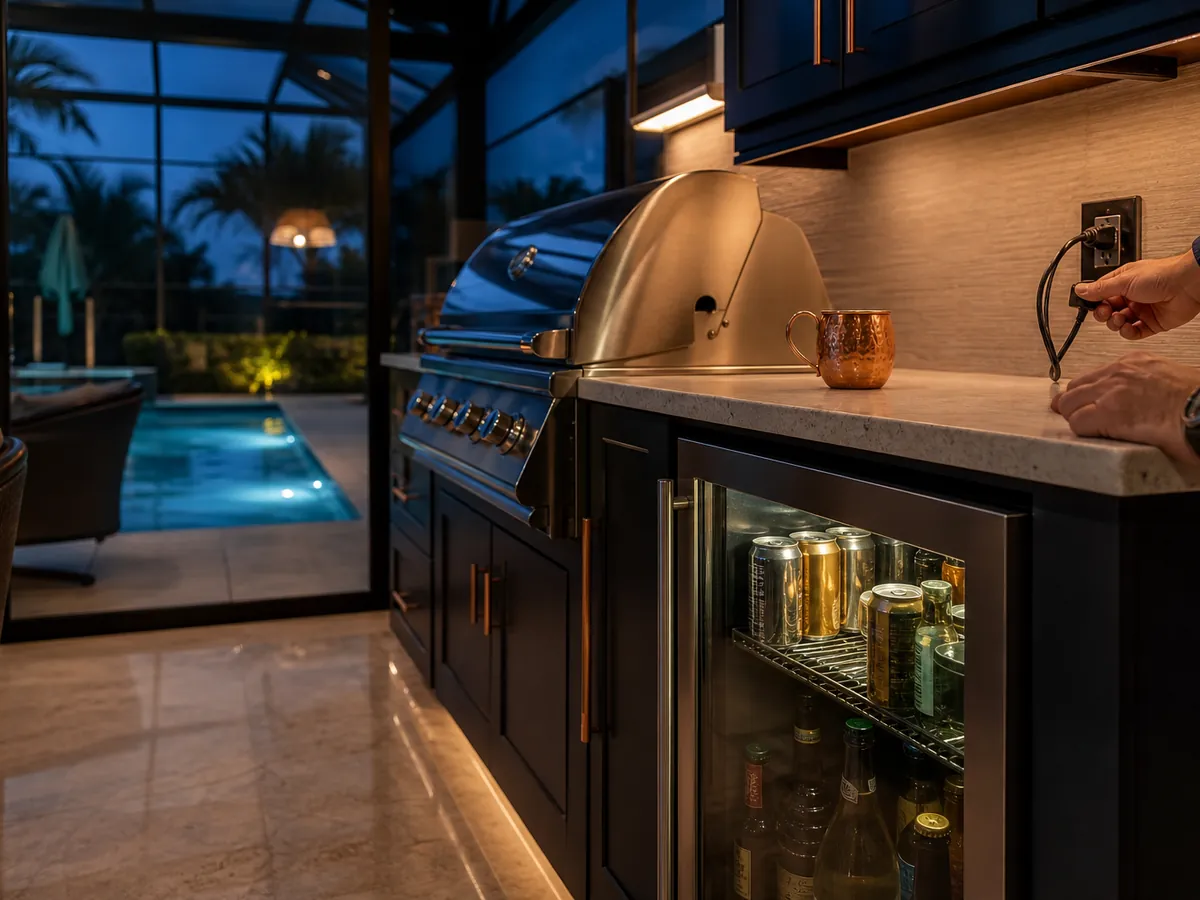
An outdoor U-Line refrigerator on a Florida lanai should plug into a working GFCI-protected outlet, with no extension cord, no power strip and no damaged plug. Rain, splashing, pool water and humidity all raise the risk of shock, so a tripped GFCI is a warning to find the cause, not an annoyance to bypass.
Why do wet outdoor spaces need GFCI protection?
A GFCI outlet watches the current going out on the hot wire and the current coming back on the neutral. If a small amount leaks away, for example through a person, it shuts off the power in a fraction of a second. Outdoor outlets are expected to have this protection because water and electricity meet there.
On a Tampa Bay lanai, moisture is constant. Summer storms blow rain sideways, pressure washing sprays the wall, and the air itself is damp for months. Salt in the air near the coast corrodes contacts faster. A GFCI outlet that has been outside for years can wear out, so test it as the manufacturer describes, and have an electrician replace it if it will not reset or does not trip when tested.
What should the cord and outlet look like?
Look at the plug and cord with the unit unplugged. Never inspect them while standing in water or with wet hands. Use the following list as a quick walk-through.
- The plug should be straight, with all prongs present and no blackened or melted spots.
- The cord should have no cuts, kinks, flattened sections or exposed wire, and it should not run under a rug or through a doorway.
- The outlet should have a weatherproof in-use cover that closes over the plug, not just a flip cap.
- The outlet should not feel warm to the touch after the unit has run for a while.
- The unit should have its own dedicated circuit where the guide calls for one.
Do not use an extension cord or a power strip with a refrigerator. A thin cord can overheat under the load of the compressor, and a wet connection point is a hazard. If the outlet is too far from the unit, ask a licensed electrician to add one in the right place.
What if the GFCI keeps tripping?
Treat it as information. Switch off the unit, unplug it, and reset the outlet. If the outlet holds with nothing plugged in, plug the unit back in. If it trips right away, the unit or its cord may be leaking current. If the outlet trips with nothing plugged in, the outlet or its wiring is the problem. In both cases, stop and do not try tape, a different outlet without protection or any workaround.
Sometimes the cause is plain water. Moisture inside the outlet box after a storm can cause nuisance trips that go away when everything dries, but do not assume that. If it happens more than once, bring in an electrician for the outlet and a technician for the appliance.
| Sign | Possible cause | What you can check | Who to call |
|---|---|---|---|
| GFCI trips right after plugging in | Current leaking from unit or cord | Unplug; inspect plug and cord with power off | Technician |
| GFCI trips with nothing plugged in | Wet or worn outlet | Cover condition; leave it unplugged | Electrician |
| Outlet or plug warm or discolored | Loose or corroded connection | Unplug and stop using the outlet | Electrician |
| Tingle when touching the cabinet | Leakage to the metal case | Unplug immediately; do not touch again | Electrician and technician |
| Unit runs but breaker trips in storms | Water in outlet box or a surge | Keep unit off until dry | Electrician |
How do you keep rain, splash and salt away?
Many outdoor models are designed for covered outdoor locations, and the guide says what exposure is acceptable. Read that section for your model. A unit under a lanai roof is not the same as a unit in an open yard, and direct spray from a hose or from a pool should be avoided. When you clean the area, switch off the unit first and keep the water away from the cabinet’s grille and controls.
Wipe down the cabinet and the area around the plug with a damp cloth rather than a spray. Salt air leaves a film, and a mild soap solution and a dry cloth keep it from building up. Check the CPSC recall page listed below for your appliance and your extension cord or power strip, since recalls are posted there.
When should you call for help?
Call an electrician for any outlet problem and a technician for any appliance that trips a breaker, hums or runs constantly, feels live to the touch or smells hot. A brief delay is better than a repair attempt on wiring. Gas smell is a separate matter: if you ever smell gas near a grill or an outdoor kitchen, leave the area, avoid switches, and call the gas utility or 911 from outside.
Before hurricane season, switch off the breaker and unplug the unit if a storm is expected, and do not power it on again after flooding or heavy water exposure until it has been inspected.
Frequently asked questions
Can I use an outdoor extension cord for my U-Line outdoor refrigerator?
It is not a good idea. A refrigerator needs a stable connection, and cords add resistance and a wet connection point. Have an electrician install an outlet within reach of the plug on its own protected circuit.
How often should I test a GFCI outlet?
Follow the instructions printed on the outlet, which commonly call for pressing the test button and confirming the reset button pops out. Outdoor outlets deserve more attention than indoor ones because weather wears them. Replace any that fail the test.
Is it safe to pressure wash near the unit?
Switch off the power first and keep the spray away from the unit, the grille and the outlet. Pressure forces water past seals. Wait until everything is dry before restoring power.
What if the unit feels like it shocks me?
Stop touching it. Switch off the breaker, unplug the unit once the area is safe, and have both an electrician and a technician inspect it. Do not use it again until the cause has been found.