Cleaning the Grille and Condenser on a U-Line Undercounter Unit
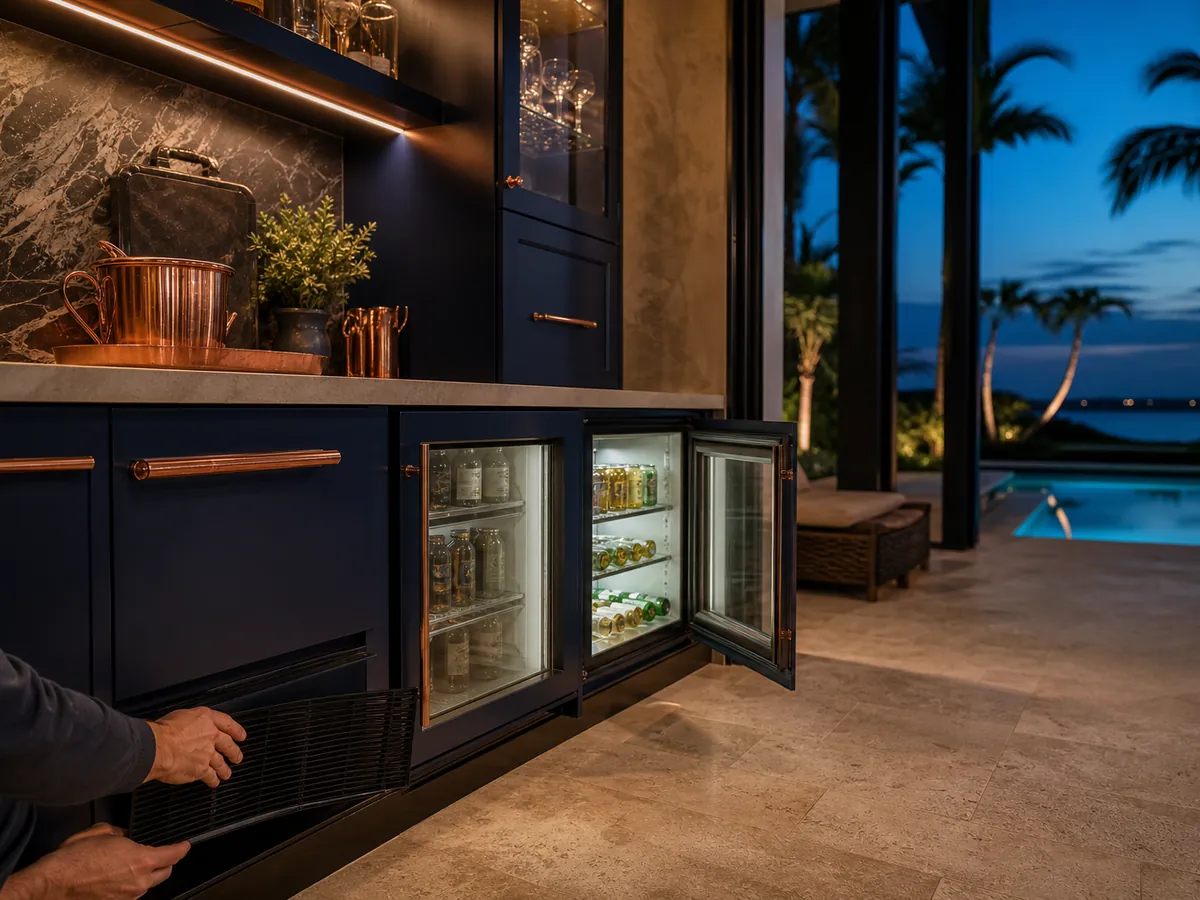
Clean the front grille and the condenser behind it whenever dust, lint or pet hair is visible, and at least a few times a year in Florida. A U-Line undercounter unit pulls room air through the grille to shed heat. When that path clogs, the unit runs longer, cools less evenly and wears harder in warm kitchens and bars.
Why does a dirty grille matter more in Florida?
Most U-Line undercounter refrigerators, freezers, wine units and beverage centers are built to breathe through the front. Air enters low on the face of the cabinet, passes over the condenser, and leaves the same way. The condenser is the finned coil that releases the heat the unit removes from your food and drinks.
Tampa Bay summers raise the temperature of the air the unit is breathing, and a bar or kitchen with the air conditioning set back while you travel can get warmer still. Add a layer of dust and the coil cannot shed heat well. The compressor then runs for longer stretches, which shows up as warm drinks, a louder hum and a higher electric bill.
How do you clean the grille and condenser safely?
Safety comes first: unplug the unit, or switch off its breaker if the cord is out of reach, and wait for the cabinet to settle. Moving parts such as the fan sit close behind the grille, and the coil fins are thin and sharp.
- Remove the front grille only if your use-and-care guide shows it coming off by hand. Many units use a lift-off or clip-in design. Do not pry or unscrew anything you are unsure about.
- Vacuum the grille slats and the visible coil face with a soft brush attachment, moving in the direction of the fins, never across them.
- Wipe the grille with a damp cloth and mild dish soap. Dry it before it goes back on.
- Look for oily lint, pet hair or kitchen grease. Grease holds dust in a mat that a vacuum alone will not lift.
- Refit the grille, restore power and let the unit run. Check that the display or temperature setting is where you left it.
Do not use a pressure washer, compressed air at close range or a wire brush. Fins bend easily, and a bent fin blocks the air you are trying to clear.
What can you check and what should a technician do?
| Sign | What you can check | What a technician does |
|---|---|---|
| Grille covered in dust | Vacuum and wipe it after unplugging the unit | Nothing needed unless cooling stays weak |
| Unit runs almost nonstop | Clearance around the front, a clogged grille, a door left ajar | Test airflow, fan and temperatures |
| Louder hum or rattle | Objects touching the cabinet, loose grille | Inspect the fan motor and mounting |
| Warm interior after cleaning | Thermostat setting, door seal, recent loading | Check the sealed system and controls |
| Oily film on the coil | Wipe the grille only | Degrease the coil with the right tools |
The coil is the part owners are most tempted to dig into, and it is also the part where mistakes cost money. If a mat of grease remains after the grille is clean, or fins look flattened, stop there. We clean coils with a brush and a vacuum made for the job, and we check the fan while we are in there.
How often should you clean it?
There is no single schedule that fits every home. A kitchen with a dog, a bar near a busy walkway or a unit beside a cooking area collects dust faster than a quiet wine nook. Look at the grille at the start of each season, and again after any renovation, since drywall dust is fine enough to coat a coil in a single weekend.
Homes near the water add salt in the air, and lanai-adjacent rooms collect pollen and yard debris every time a door opens. Those homes are worth checking more often. Follow the interval in your use-and-care guide if it gives one, and shorten it if the grille is clearly dirty sooner.
What else keeps an undercounter unit breathing?
Cleaning only helps if air can actually reach the grille. Keep the space in front of the unit clear, and do not stack boxes, ice buckets or bar towels against it. If a filler panel, a toe kick cover or a decorative panel was added after installation, make sure the front opening is still open. We see this in remodeled kitchens more than you might expect.
Keep the door seal in good shape too. A gasket coated in syrup or spilled wine will not close fully, and a unit that cannot hold cold will work hard even with a spotless coil. Wipe the gasket with warm water and a little mild soap, then dry it.
If you have cleaned the grille and the unit still struggles, the cause is somewhere else, such as a fan, a control or the sealed system. Do not open panels or touch refrigerant lines. That work needs the right tools and proper refrigerant handling.
Frequently asked questions
Can I use a household vacuum on the condenser?
Yes, with the unit unplugged and a soft brush attachment, working lightly along the fins. Skip hard nozzles, and stop if you meet resistance. A vacuum picks up loose dust but not grease, so a sticky coil still needs a technician.
Will cleaning the condenser lower my electric bill?
It can help, because a unit that sheds heat easily runs fewer hours. We cannot promise a specific saving, since it depends on the room, the load and how dirty the coil was before.
Is it safe to remove the grille myself?
Only if your use-and-care guide shows a tool-free removal, and only with power off. If the grille is screwed on, hidden behind a custom panel or hard to reach, leave it for a service visit.
Does cleaning the grille affect my warranty?
Routine cleaning described in the use-and-care guide is part of normal ownership. Independent service does not by itself void a warranty, but check your warranty terms or ask us if you are unsure.